Posts

Whose hands are biggest? You may be surprised.
Image
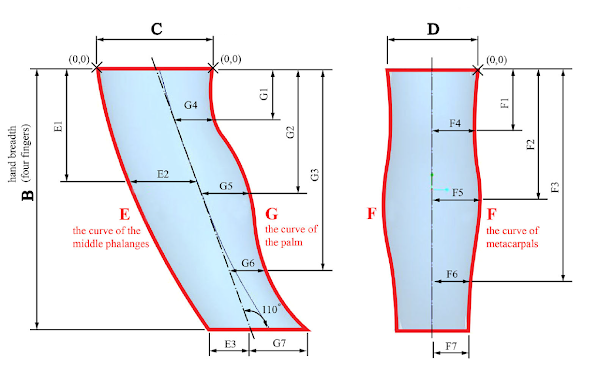
A recent project to create an ergonomic handle for 3D printing led me down a path that introduced me to anthropometric measurements of the human hand, which in turn revealed some interesting facts about hand sizes. I had no idea that hand size is dependent on nationality, but I found a number of research articles on this topic. For those who don't want to read further, the answer to the title question is: Based on the data found, Filipino males have the biggest hands, by a significant margin. In fact, the margin is large enough that this population may be considered an outlier from the general human population with respect to hand size. Even Filipina females have larger hands than most males of other nationalities. On the other end of the spectrum, Vietnamese females and Indian females have the smallest hands. Now you can read on for the whole story, or you can skip down to the chart at the end. Idea for a toy My unintentional investigation into hand sizes started while de...
It seems I created a meme

Image
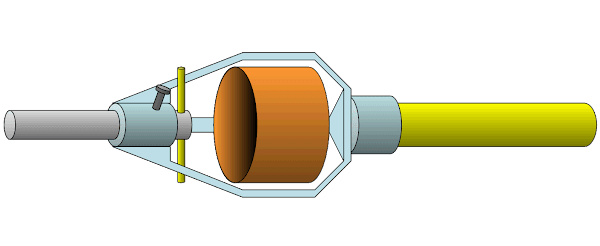
Back in July 2005 I became intrigued with crafting weird and improbable magical items for the amusement of my Dungeons and Dragons gaming group. At the time, I had also been employed in the defense industry for about half my life, working around various weapons systems. Naturally, these things came together in creating a couple of D&D weapons, one of which became a meme in both D&D and in engineering circles . It started like this. Gary, one of the other players in our group, sent out an email to the other players warning about a possible dirty trick that Ian (our Dungeon Master) might play on those of us playing characters who rely on magic and magical items: Conventional D&D wisdom states that placing a rod of cancellation into a bag of holding, handy haversack, or portable hole will destroy both items in a massive explosion. I dunno if Ian is going to spring this to annoy folks who are carrying too much equipment, but you may want to store unidentified wands outs...

My favorite mathematical card trick

Image
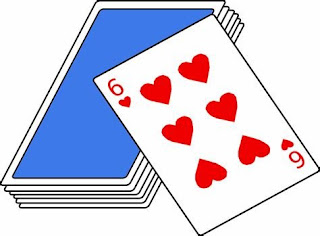
I learned this card trick in the fourth grade, decades ago, before the World Wide Web existed. I have never seen it written about, and anyone to whom I have shown it has never seen it either. This is surprising given how long I've known this trick. Did a brilliant classmate (or a parent) invent it? I'd love to know the origin. This is a mathematical card trick. Meaning, there is no sleight of hand, no actual trickery, just manipulation of playing cards that gives a surprising, final result. You can find many examples of mathematical card tricks on the internet; some of them appear downright magical and quite impressive. What the audience sees Here is how this trick appears to the audience. It looks like many steps, but they are easy to remember after you've practiced the trick even once: Starting with a deck of 52 cards (no jokers), you ask a volunteer from your audience shuffle the deck. You deal out the cards into seemingly arbitrary face-up piles, handing t...

Legitimate uses of loaded dice

Image
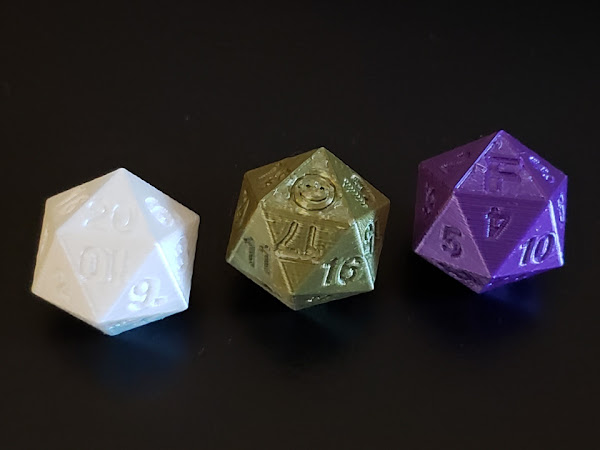
A game master / dungeon master (DM) should never allow a player to bring 3D printed dice to a game. However, a DM could supply them to players, for certain purposes. In this article I examine the characteristics of "most fair" and "most unfair" designs of d20 dice, which I made in a CAD program and 3D printed for experiments. A fair and balanced d20 (white), a d20 biased to 20 (bronze, with the ☺ on the 20 face), and a d20 biased to 1 (purple, with the F for "fail" on the 1 face). A d20 is a twenty-sided icosahedron with faces numbered from 1 to 20. In the game Dungeons and Dragons , the d20 is ubiquitous. It determines success or failure of an action. It is the first thing rolled any time a player takes an action. The result of the d20 roll, with some modifiers added based on the player's character abilities and skills, determines whether the player's action succeeds or fails, with appropriate consequences. Advantage and disadvantage...

Simulating erosion

Image
I decided to create a procedurally-generated 3D landscape in a CAD program, and wrap it around a globe, which led me to an investigation of erosion algorithms. I include a JavaScript erosion demo at the end of this article for you to play with. As an aside, let me say that I like OpenSCAD in spite of its idiosyncrasies. Other CAD programs can do many things that OpenSCAD can't, but OpenSCAD is the only 3D modelling software I know of that makes it easy to create procedural or algorithmic parametric designs. It runs on all my computers: Windows, macOS, and Linux — and it's freeware. Its main idiosyncrasy is that it uses a declarative language that requires familiarity with functional programming , a different programming mindset in which all values are evaluated at compile-time instead of run-time, meaning that all "variables" are effectively constants. Even so, one still has conditional branching, looping, and recursive functions, so one can get stuff done. For exa...

Popular posts from this blog

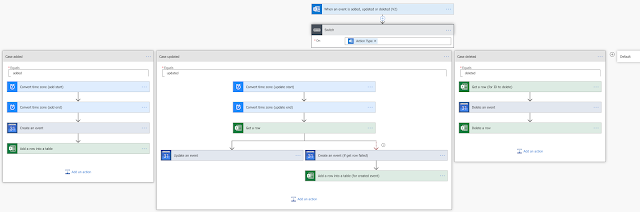
Syncing Office 365 Outlook to Google calendar using Power Automate

Whose hands are biggest? You may be surprised.

Elliptical-blade NACA airfoil propeller